
The Short Version
Joshua Tree is one of the most rewarding RV camping destinations in Southern California; otherworldly rock formations, 300 miles of hiking trails, and some of the clearest night skies within driving distance of Los Angeles. But the desert demands preparation. Only 3 of 8 campgrounds accept RVs, most campgrounds have no running water, and summer temperatures regularly exceed 110°F.
- Best campgrounds for RVs: Black Rock (99 sites, water, flush toilets, dump station) and Cottonwood (62 sites, water, flush toilets, dump station) — the only two with full facilities
- RV size limit at most campgrounds: 25 feet combined length — a hard limit at Indian Cove, Hidden Valley, and White Tank
- Season: October through May — several campgrounds close or face heat-related closures in summer
- Free camping: BLM land north and south of the park offers dispersed boondocking at no cost
Which Joshua Tree campgrounds accept RVs?
Joshua Tree has 8 campgrounds, but most weren't designed for RVs. Jumbo Rocks (the park's most popular campground) and Ryan don't accept RVs or trailers at all. The remaining 6 accept them with tight restrictions — and only 2 have the amenities RV campers actually need.
Reservation campgrounds
The three reservation campgrounds all charge $35/night and stay open year-round, subject to summer heat closures.
Black Rock is the top pick for RV campers. It has 99 sites at 4,000 feet on the park’s west side, with running water at every site, flush toilets, and one of only two dump stations in the park ($5 fee). It's also the only campground with direct access to the Hi-View Nature Trail and a short drive to the West Entrance. The elevation keeps temperatures 10–15 degrees cooler than the valley floor. It's open year-round, subject to summer heat closures.
Cottonwood has 62 sites at $35/night and sits at 3,000 feet near the park’s south entrance odd Interstate 10. Same amenities as Black Rock - water, flush toilets, dump stations ($5) — and the same year-round-but-heat-dependent season. It's the closest campground to the Cholla Cactus Garden and the trailhead for Mastodon Peak. Less crowded than Black Rock because it's farther from the park's most famous rock formations.
Indian Cove has 101 sites at $35/night and is sandwiched between massive boulder piles on the park's north side — visually striking, but limited for RVs. The combined vehicle-plus-trailer limit is 25 feet, there's no running water, no dump station, and pit toilets are the only facilities. It's reservation-only, open year-round (subject to heat closures), and popular with rock climbers.
First-come, first-served campgrounds
The three first-come campgrounds all charge $25/night, have no running water, and offer pit toilets only.
Belle technically accepts the longest RVs in the park — up to 35 feet — but NPS notes that most of its 18 sites realistically fit 25–30 feet. No water, no dump station, pit toilets, $25/night. It closes for the summer, and the rest of the year it's first-come and fills fast on weekends from October through May.
Hidden Valley (44 sites) and White Tank (15 sites) both cap at 25 feet combined length, charge $25/night, and have no water — just pit toilets. Hidden Valley is the only first-come campground open year-round, and it's surrounded by the park's best bouldering terrain. White Tank, the smallest campground in the park, closes for the summer.
What are the RV size limits at Joshua Tree?
The 25-foot limit is the number that matters most. Here's the breakdown: Belle posts the highest ceiling at 35 feet, though most of its sites realistically fit 25–30 feet. Indian Cove, Hidden Valley, and White Tank all cap at 25 feet combined length. Black Rock and Cottonwood vary by site, so check recreation.gov for individual site dimensions before you book. And Jumbo Rocks and Ryan don't take RVs at all.
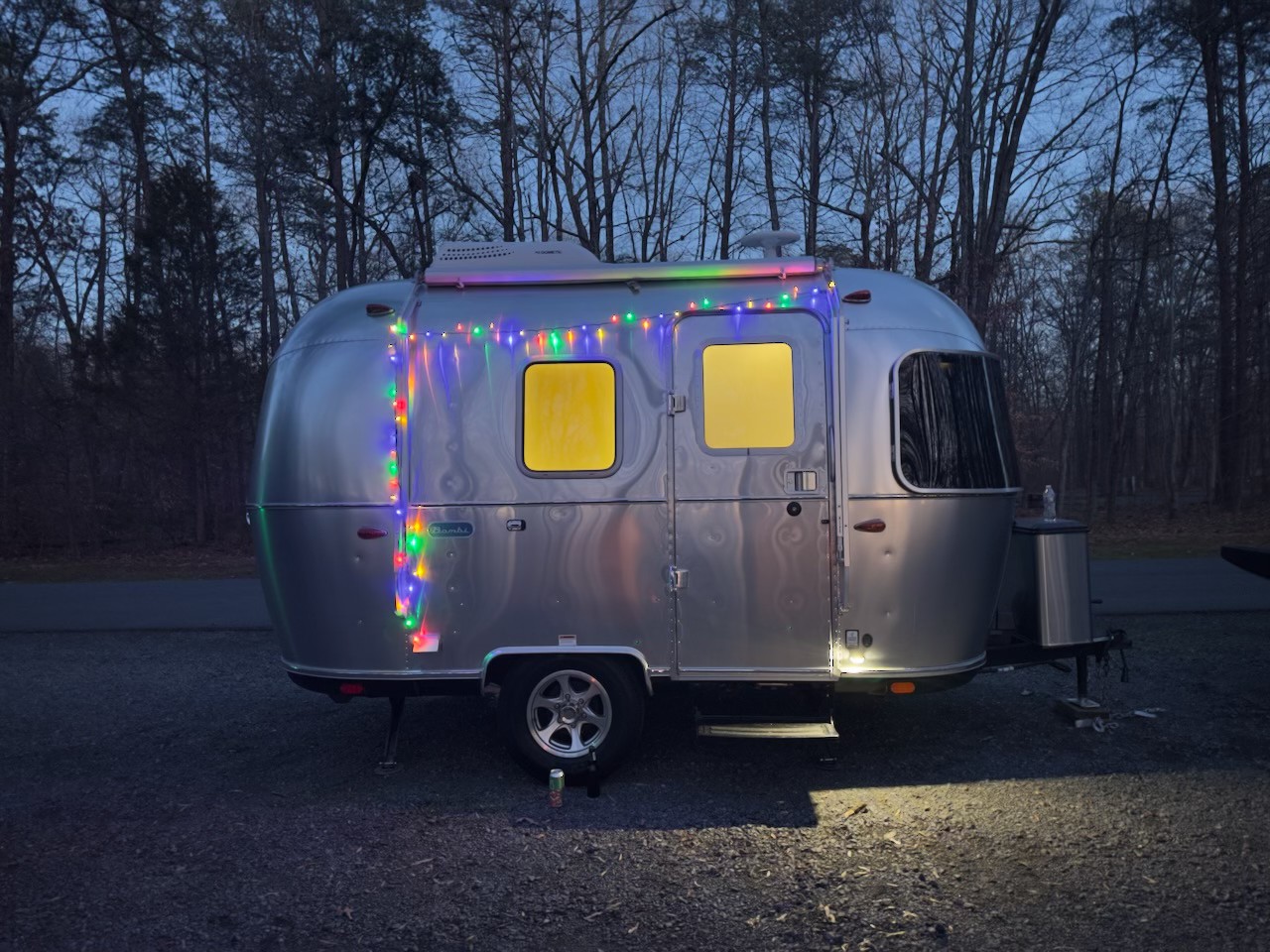
"Combined length" means your tow vehicle plus trailer, or your motorhome including any towed car. A 20-foot travel trailer behind a pickup truck already exceeds 25 feet combined.
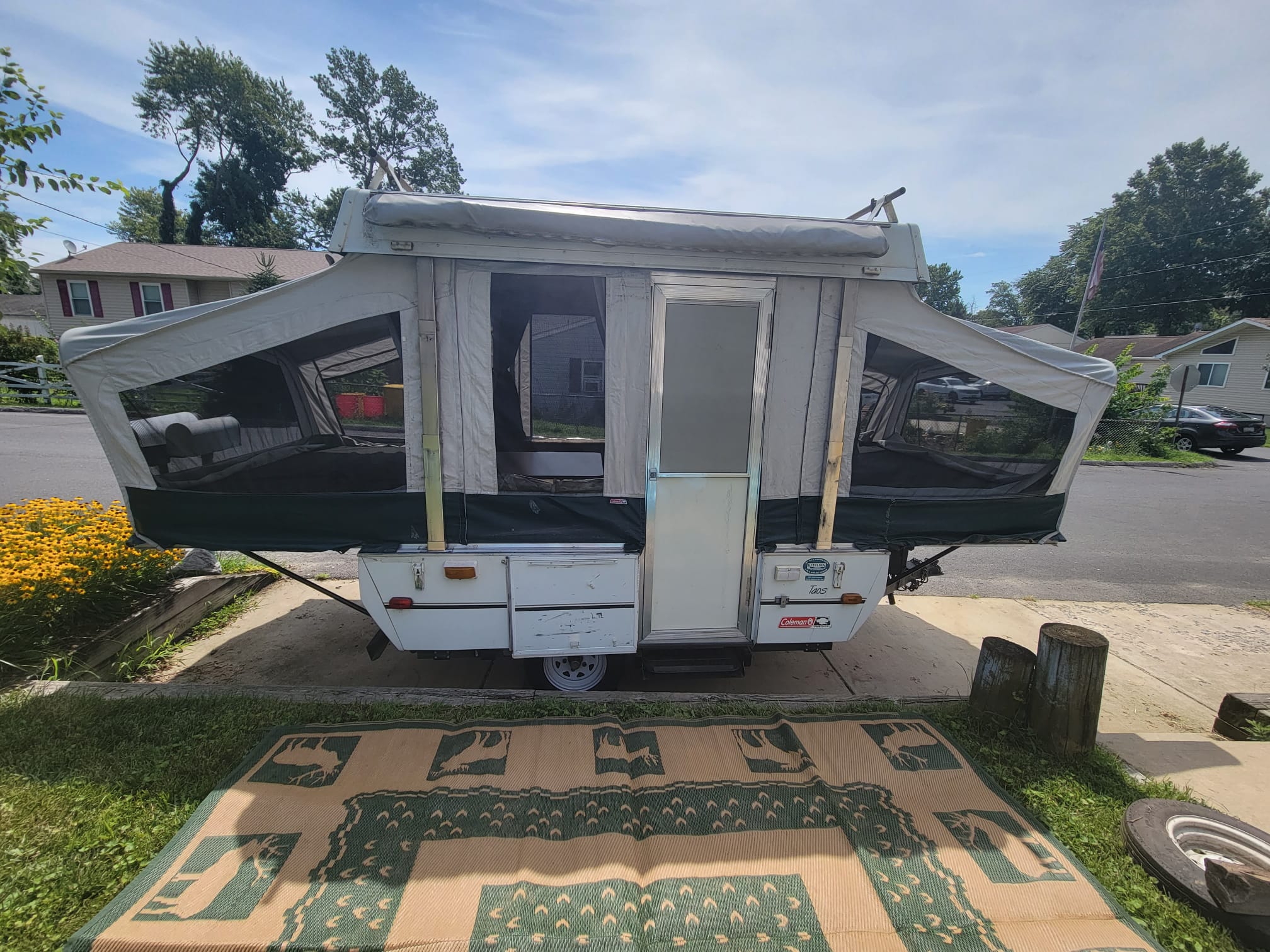
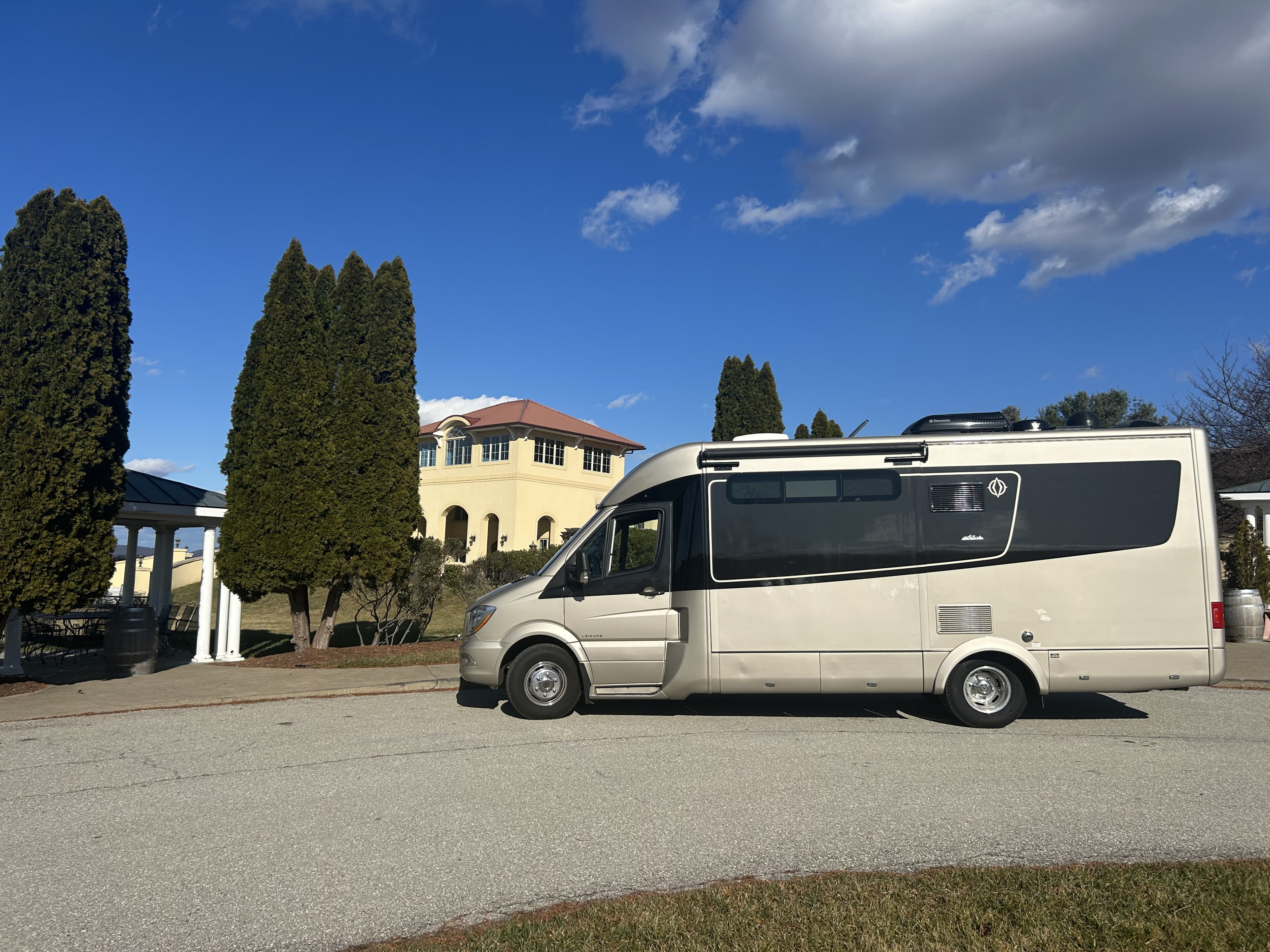
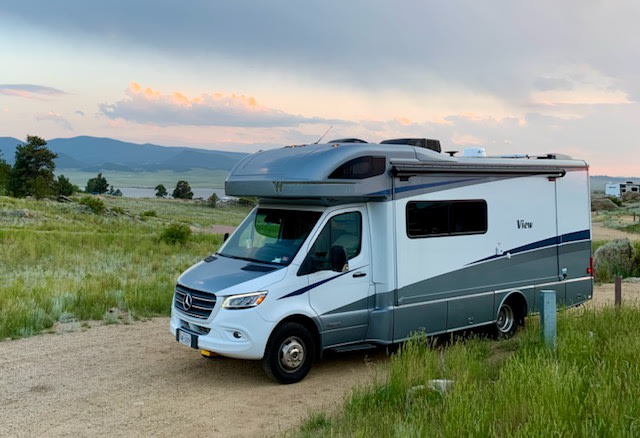
In our experience, first-time desert RV campers underestimate how tight these limits are. The pattern we see from renters heading to Joshua Tree: they book a 30-foot Class C and then discover most campgrounds max out at 25 feet — sizing down before you arrive saves a stressful campground shuffle. For Joshua Tree specifically, a Class B campervan or a small Class C under 25 feet is the practical choice.
Road note: The park's main paved roads handle standard RVs without issue. The unpaved backcountry roads — Geology Tour Road, Old Dale Road, Covington Flats — are 4WD-only and not suitable for any RV.
What should RV campers know about desert camping at Joshua Tree?
The desert is a different animal than mountain or forest camping. Here's what catches people off guard.
Water is scarce. Only Black Rock and Cottonwood have running water. Every other campground is dry camping — you bring every drop you need. A family of four uses 20–30 gallons per day with conservative use. Fill your freshwater tank completely before entering the park. The nearest towns for water refills are Twentynine Palms (north), Joshua Tree town (northwest), or Desert Hot Springs (west).
Heat will close the park. Summer daytime temperatures regularly exceed 110°F in the lower elevations. Several campgrounds close from June through September for heat-related safety. Even campgrounds that stay "open" (like Black Rock and Cottonwood) may close temporarily during extreme heat events. The NPS does not consider Joshua Tree a summer camping destination.
Generator hours are strict. Generators are allowed only from 7–9 a.m., noon–2 p.m., and 5–7 p.m. — six hours total per day. Outside those windows, quiet hours are enforced. Bring portable solar panels or battery banks if you need to charge devices or run a CPAP at night.
Campfire restrictions are seasonal. Open campfires are banned from June 15 through October 1. Propane stoves are allowed year-round. Outside the fire ban window, campfires are permitted in provided fire grates — bring your own firewood (collecting park wood is illegal).
Wind is relentless at elevation. Black Rock (4,000 ft) and the higher campgrounds catch steady desert winds. Secure awnings, pack windbreaks, and expect sand in everything.
Wildlife is real. Rattlesnakes, scorpions, and black widows are active in warmer months. Check shoes before putting them on, keep food stored, and watch where kids put their hands around rock piles.
Can you boondock near Joshua Tree?
Yes — and it's one of the best boondocking destinations in California. Bureau of Land Management (BLM) land borders Joshua Tree on the north and south sides, and dispersed camping is free.
North of the park: A wide, flat section of BLM land off Highway 62 near Twentynine Palms accommodates RVs of any size. The terrain is open desert — no shade, no facilities, no water, no trash service. Wind is the main challenge. No 4WD required for the main access areas.
South of the park: BLM land off Cottonwood Springs Road (south of the park's Cottonwood entrance) has dozens of established pull-off sites large enough for big rigs. Some access roads are rougher — 4WD is recommended for deeper sites, but the main pulls are accessible to standard RVs.
The rules:
- 14-day stay limit in any one spot
- No hookups, no water, no trash service — pack everything out
- Campfires: check current BLM fire restrictions for Riverside County
- No fees, no reservations needed
- Cell service is spotty to nonexistent
Hosts who list RVs near Palm Springs and Los Angeles tell us the most common mistake is arriving in summer — Joshua Tree regularly tops 110°F from June through September, and the BLM land offers zero shade. Boondocking here is a fall-through-spring activity.
What are the best things to do at Joshua Tree?
Joshua Tree packs more variety into its 800,000 acres than its "desert park" label suggests.
Short hikes and nature walks:
- Cholla Cactus Garden (0.25 miles, flat) — a dense field of teddy bear cholla cacti that glow golden at sunset. The short boardwalk loop is one of the most photographed spots in the park. Near the Cottonwood campground area.
- Skull Rock Trail (1.7 miles, easy) — starts at the Jumbo Rocks area and passes the park's most recognizable rock formation. Flat, sandy, kid-friendly.
- Barker Dam Loop (1.3 miles, easy) — a historic cattle-ranching dam that creates a small lake after rain. Petroglyphs visible along the trail. Family-friendly distance.
- Arch Rock Trail (1.4 miles, easy) — leads to a natural granite arch. The trail threads through boulder fields that kids treat as a jungle gym.
Viewpoints:
- Keys View (short paved walk from the parking lot) — panoramic view from 5,185 feet that spans the Coachella Valley, Salton Sea, San Andreas Fault, and the San Gorgonio and San Jacinto mountain ranges. Accessible by RV on paved road.
Stargazing:
Joshua Tree earned its International Dark Sky Park designation in 2017. We've heard from renters that the stargazing at Joshua Tree is what keeps them coming back — it's one of the few places within a few hours of LA where the Milky Way is visible to the naked eye. Best viewing is during new moon phases from November through March.
Rock climbing:
The park has an estimated 8,000 established climbing routes and 2,000 bouldering problems. Hidden Valley and Indian Cove campgrounds put you right in the heart of the climbing terrain.
Where should you rent an RV for Joshua Tree?
Three cities put you within easy driving distance:
Palm Springs — 45 minutes to the park's West Entrance via Highway 62. The closest pickup option. Short drive means less fuel and more time at the park.
Los Angeles — 2.5 hours via I-10 East to Highway 62. The largest rental market in the region, with the widest selection of RV types and price points.
San Diego — 3 hours via I-15 North to I-10 East. A strong option if you're combining Joshua Tree with an Anza-Borrego Desert State Park stop.
Size recommendation: Go smaller than you think. A Class B campervan or a compact Class C under 25 feet fits every campground in the park. Anything over 25 feet limits you to Black Rock, Cottonwood, and Belle — and Belle's sites are tight at 30+ feet. Check the California RV campground guide for more options beyond the park.
When is the best time to RV camp at Joshua Tree?
Late October through April is the camping season — and the park essentially shuts down for RV camping outside that window.
Fall (October–November): The heat breaks. Daytime temperatures drop to the 70s–80s. All campgrounds reopen after summer closures. Crowds are moderate. First-come campgrounds fill on weekends but have midweek availability. This is the window to book if you want comfortable temperatures without spring break crowds.
Winter (December–February): Daytime highs in the 50s–60s, overnight lows in the 30s (dipping below freezing at higher campgrounds like Black Rock). Crowds thin. Stargazing is at its best — cold, dry air with the longest nights. The park entrance fee is $30 per vehicle for 7 days, or $55 for an annual pass. RV campers with cold-weather setups get the quietest, clearest Joshua Tree experience.
Spring (March–May): Peak season. Wildflowers bloom after winter rains — the desert floor can erupt with color from mid-March through April. Temperatures are perfect (70s–80s). But first-come campgrounds are typically full by Friday afternoon, and reservation campgrounds sell out months ahead. Plan early.
Summer (June–September): Avoid it. Temperatures routinely exceed 110°F. Multiple campgrounds close. The NPS actively discourages camping. Even BLM boondocking is dangerous without shade or reliable cooling.
About this guide
This guide draws on National Park Service campground data for Joshua Tree and Recreation.gov's Joshua Tree gateway listing for campground availability and reservation details. Activity recommendations reference NPS Joshua Tree things to do. Stargazing information references Joshua Tree's International Dark Sky Park designation through DarkSky International. Campground fees, site counts, RV length limits, and season details were verified against NPS sources as of August 2026. RV rental market observations come from Outdoorsy's booking data across Los Angeles, San Diego, and Palm Springs.